02 / Services
Troubleshooting and technical assistance
Electrical and electronic troubleshooting and repair. Support in port and at anchor, with travel to other islands and Mediterranean locations subject to availability.
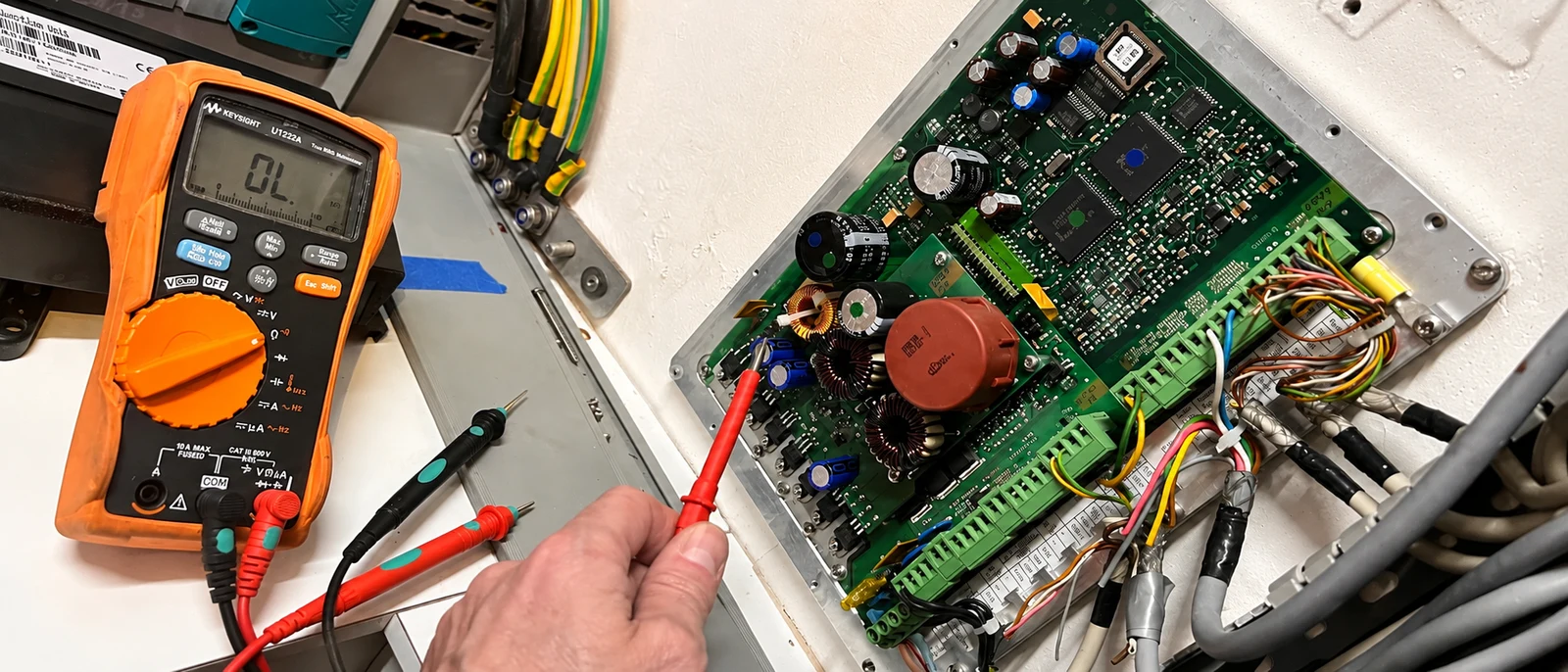
Support wherever the boat is
I troubleshoot electrical and electronic faults on board, both in port and at anchor. I also travel to neighbouring islands and other Mediterranean locations, depending on the boat’s location and my availability. Whether a fault is permanent or comes and goes, the aim is to find its cause and provide a useful solution as promptly as possible.
I value my clients’ time as much as my own. Some have worked with me for more than twenty years, and that continuity creates close relationships, sometimes becoming friendships. On most call-outs I am able to find a solution for the client. My reputation has grown through solving problems and being there when needed; every fault still needs investigation before I can promise an outcome.
Reconstructing events before taking things apart
Diagnosis starts with listening. What happened, which equipment was running, what had changed and what the people on board saw. A manoeuvre, previous work or a seemingly unrelated event may provide the missing clue.
Sometimes a quiet conversation over a coffee, studying diagrams, reviewing notes and talking to users achieves more than starting to dismantle equipment without a hypothesis. I approach a fault as an investigation: observation, questions, imagination to consider possibilities and logic to check them against measurements.
Tracking down the “ghosts”
A permanent fault is usually easier to identify. Intermittent faults require understanding the conditions in which they occur and observing them for longer. For computer networks and communication protocols, I use traffic captures —sniffing—, data logging and extended measurements where needed to connect a failure with events on board.
Working quickly does not mean skipping steps. It means choosing tests that provide useful information and avoid going round in circles or replacing parts without a reason.
Listening to signals and tracing cables
Alongside conventional electrical checks, I use non-contact radio-frequency reception techniques to look for signs of activity in certain cables. Over the years I have trained my ear to recognise patterns that offer clues about different signals and communications. I then cross-check those clues with other tests.
I also locate and trace multicore, coaxial and data cables. When standard equipment is not enough, I adapt or develop tools for the specific job. I have done this many times: the tool needs to answer the question we are trying to resolve.
Leakage currents and corrosion problems
I also investigate faults involving leakage currents, electrical insulation, galvanic corrosion and galvanic isolators. I review connections and the history of the installation alongside measurements, distinguishing possible causes rather than attributing every symptom to the same problem.
Damage to the hull, metal components or other areas of the boat also forms part of the investigation. Any connection between visible damage and an electrical cause needs to be established for the individual case.
Tell me the symptoms, even if they seem unrelated
Tell me where the boat is, what has stopped working and when it started. Photographs, videos, error messages, diagrams and recent changes help me prepare for the visit. You do not need to arrive with a diagnosis: describing what you have observed, including apparently unrelated details, can be the best starting point.
Shall we talk about your boat?
Tell me what you need and we can discuss the next step.